|
|||||||||||||||||||||||||||||||||||||||||||||||||||||||||||||||||||
       |
|||||||||||||||||||||||||||||||||||||||||||||||||||||||||||||||||||
The Spanish Conquest and ColonizationLocation: Rediscover Machu Picchu > The Inca Civilization > The Spanish Conquest and Colonization -----------------------------------------------------------------------------------------------------------------------------------------------------------------------------------------------------------------
Francisco Pizarro and His Journeys to South America
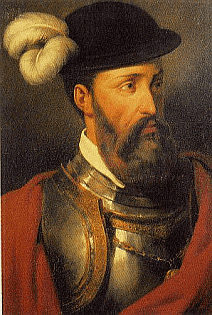
The conquistador Francisco Pizarro is considered along with Hernán Cortés, his cousin, an important Spanish military commander who had conquered new lands for Spain in the "New World" ("Nuevo Mundo") Francisco Pizarro is credited with the occupation of the Inca lands called "Tahuantinsuyo", at that time Although he had been a ferocious cruel invader, many of his statues are found in Peru and Spain. Of course, the Inca leaders are also present in today's Peru.
We know little about Pizarro's early life, but we know that he was born in Trujillo, Spain (Extremadura region) in 1475 or 1476 (exact date unclear), as the son of Gonzalo Pizarro, an infantry colonel who served in Italy under Don Gonzalo Fernández de Córdoba in the city of Navarra. Francisco Pizarro was neglected by his parents and relatives and hasn't received enough education during his lifetime, reason why he remained illiterate all his life.
In 1492 the "New World" or "Nuevo Mundo" was discovered by Christopher Columbus. Pizarro felt attracted by adventure and loved the military lifestyle, had chosen to take part in several missions along with his famous cousin, Hernán Cortés (he had been fighting with the Mayas in today's Mexico). Pizarro's first experience with the newly discovered American continent was in 1509. In 1510, Pizarro went on an expedition to a place called Urab under Alonso de Ojeda. He was selected to be in charge of a small settlement called San Sabastian.
Later, Pizarro accompanied Vasco Núñez de Balboa in explorations on the Pacific Ocean. He had received a "repartimiento" under Pedro Arias de Ávila and for a while, worked as a cattle farmer in today's Panama.
He has travelled to today's Peru in the 1520s, where he had clashes with Inca forces. The mighty Inca Empire wasn't hard to conquer for the skilled, well-armed conquistadores with cannons, pistols and modern armour... Some of them were cavalry men. The Incas were no match for them.
Pizarro was renowned for his cruelty and greed for gold. His bloody invasion of the "New World's" left death and destruction around him. The Incas feared the conquistadores like Europeans feared Gingis Khan.
Pizarro had conquered most of the Inca Empire during his lifetime and 40 years after his death, other conquistadores continued to fight with the poorly-armed Incas until the empire's territories finally became Spanish.
Pizarro founded Lima, the capital of Peru and has earned the title "Governor of Peru" in his late years.
Pizarro and the El Dorado
Interestingly, the El Dorado legend is often mistakenly linked to Peru and the Incas, but it has nothing to do with this part of Latin America. The El Dorado is about the story of a "Golden Man" who had vanished in a lake - it is a Muisca Indian legend. It was believed that the "Golden Man" had hidden treasures into a lake (later identified as Lake Guatavita in today's Colombia).
Francisco Pizarro and his men believed in the legend. The literally took the symbolical words "Golden Man" and tried to drain the lake. Guatavita Lake is a crater lake. Pizarro and his man have cut down the edge of the crate in a V-shape, but then abandoned the tremendous work. Even today, the V-cut is visible on the perimeter of the crater.
The Journey to Peru and the Conquest of the Inca Empire
Pizarro met with priest Hernando de Luque and in 1522 with a soldier called Diego de Almagro (who as a baby was found abandoned on the stairs of a church). That same year, the three had decided to create a partnership for exploring the southern parts of the Americas. Which were then still unknown, unmapped, yet tales, myths about tremendous riches and gold especially circulated among the Spaniards.
Don de Luque, Francisco Pizarro and Diego de Almagro had agreed to conquer and evenly split the territories as well as the treasures that they were to find. Seduced by the idea of the El Dorado myth about a legendary land of gold about which most Spanish sailors and army men were talking about, the three men for the southern Americas.
After several journeys to various parts of northwestern South America, Pizarro, de Luque and Diego de Almagro had decided to go to the lands that today we call Peru.
De Luque, priest, was the most influent at the beginning, he and de Almagro have offered their whole fortunes for financing this trip. Pizarro on the other hand, was poor. He symbolically offered his sword. He was the military leader. De Luque became responsible with communications with the Spanish authorities, Diego de Almagro was responsible for the supplies.
Initially, the expedition force had 2 ships, about 100 men and 1 cannon. The first departure had taken place in 1524, but due to the leader's inexperience in navigation and little knowledge of the seas, the ships weren't even able to reach the equator. They had to return to Spain. Only in 1526 had they managed to reach the equator and only in 1527 could Pizarro together with Diego de Almagro reach today's Peru.
Pizarro has started his trip with little experience and with mostly unreliable men. He had to face crew disobedience and even conflicts, similarly to Christopher Columbus.
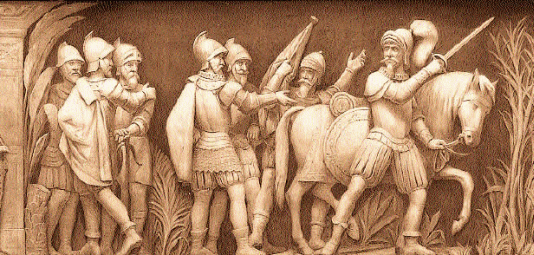
Panama's corrupt governor, Pedro d Los Rios had sent a ship of armed men against Pizarro's forces who had their camp set on an island in the Pacific, not far away from Panama. Pizarro and his team were facing difficulties with supplies and were waiting on the island for Don de Luque to return with help. At the sighting of the enemy ship, Pizarro's men jumped up in joy, believing that it was de Luque returning with the supplies. The were wrong... De Rios had sent his men to kill Pizarro. Armed Spaniards disembarked from the galleon, but eventually the fight did not take place. Many of Pizarro's men have switched sides and went with the Panamanians. They wanted to end the exhausting experience they had during the travels with Pizarro. It was then when Francisco Pizarro took his sword out and drew a line in the sand. Then, he told his men to choose... Thos who wanted to continue the trip with him had to step on his side of the line. Only 13 did.
On the image below, you can see the "Pizarro Going to Peru", scene by Constantino Brumidi, created sometime between 1878 and 1880. It can be found in the United States Capitol:
In 1535 the Inca Empire was suffering from the first smallpox epidemic ever. The locals were not used to this new illness brought by Europeans and many have died.
The Inca Emperor, Huayna Capac had died of smallpox and his son, Huascár was appointed the ruler of the empire by the by the court elite. But, Atahualpa, his other son had control over his father's professional army and was successful in conquering regions in Ecuador and Colombia. Luckily for the Spaniards, the inheritance war between the two sons had a weakening effect over the empire.
Atahualpa had overcome his brother, Huascár, whom he had executed together with his whole family. Atahualpa invited the Spaniards to a feat, believing that they were not much of a threat to the Incas. Pizarro tried luring Atahualpa into his side, but had even blackmailed him and ambushed him, killing thousands of his men. Pizarro needed Atahualpa's support in order to dominate the Incas, who would listen to their ruler.
Atahualpa was taken hostage by Pizarro and the Inca, fearing death, has offered to ask for treasures from his followers in order for him to be released. In the cell, Pizarro promised to let him go, if the treasures will pile as high as the conquistador could point with his hand. So the Incas brought so much silver and gold that they almost filled the room. The Spaniards were shocked. 13.420 pounds of silver and 26.000 pounds of gold were brought, but the Inca leader was still murdered in a sadistic way: Atahualpa asked not to be burned, because in Inca mythology, if someone burns, his/her soul cannot reach heaven, Pizarro promised him that he won't be burned, then Atahualpa was suffocated, after that, his body was burned - with despise towards him and his beliefs).
Pizarro had 3 brothers: Hernando, Juán and Gonzalo. they were his most loyal allies in the colonization war. Juán was the smallest brother and he fell at the battle of Sacsayhuamán, near Cuzco (Cusco) - the capital of the Inca Empire. Juán Pizarro was fatally wounded in the battle, after falling from the massive wall of the fortress. He died the next day.
Cuzco fell to the Spaniards, but several Inca attacks followed over time, with little success. After Cuzco was taken, Pizarro founded Lima, the capital of today's Peru. Pizarro called Lima "Ciudád de los Reyes", in English, meaning, "City of the Kings".
Pizarro's heavily armed and experienced men were powerful enemies facing many more, but poorly armed and often naive Incas. The latter ones were no match to the Europeans who were strongly armored, had horses and even cannons. Christian fanaticism was ruthless with the Incas. The Christians had despise to Inca values and applied brute force to demolish everything that was non-Christian. We ache today when seeing the remains of the Inca cities which had once thrived. Priest Bartolomeo de Las Cassas writes about the colonization of the Inca Empire as the "inferno of Peru". The most well-preserved Inca city is Machu Picchu, which lay hidden from the eyes of the conquistadores. We can see the evolved skills of the Incas and we can imagine how other cities could have looked like... Unfortunately, most of the Inca cities were destroyed. What the Inca civilization had created in decades, centuries was demolished in just a few years!
After Atahualpa was killed, Pizarro named Huascár's brother, Manco Cápac II, as the ruler of the Inca Empire. Together with Manco Cápac II, Pizarro destroyed Atahualpa's remaining army.
Manco Cápac II was a Spanish "puppet ruler" of the Incas, he was allowed to rule Cuzco. Due to continuous Spanish persecutions, he attempted an unsuccessful revolt in Cuzco.
The Spaniards have managed to overcome the Incas in Cuzco, the capital of the Inca Empire, but this wasn't enough to control the whole country. Contrary to what they had been trained for in Europe. The Inca Empire, broken into pieces, small areas were still controlled by the Incas. The fighting went on, especially in the remote areas with forests and valleys, mountains and wild animals, which made passage and camping for the Spaniards very difficult.
Manco Cápac II retreated with his fellow Incas to the wild and dangerous Vilcabamba Valley. There they managed to hold strong positions for quite a while. In the Vilcabamba, the "Last Capital of the Incas", Vitcos and the "Last Stronghold of the Incas", Vilcabamba had been the last places of resistance for the Incas. Until the Spaniards have overcome there too.
Following the ruthless occupation (destruction of cities and brutal torture, killings by the Spanish army), the colonization period has started. The Inca culture was partly modified, Hispanicized, the Incas were not allowed to practice their religion, were forced to become Catholics.
Conflict had broken out between Pizarro and Diego de Almagro. They have become rather rivals than friends. Diego de Almagro's power grew and he was credited with the title "Governor of Cuzco". Later, de Almagro discovered Chile and went on to discover and conquer new lands. Eventually, Pizarro and his brothers had Diego de Almagro caught and executed.
In 1541 Pizarro was assassinated by the men of Diego de Almagro II (the son of Diego de Almagro). They stormed the old, 70 year-old Pizarro's palace and stabbed him in the back. All this happened in Lima. Pizarro was overthrown as governor, then Diego de Almagro II or "El Mozo" has become the governor.
The Inca Empire was the World's second largest empire, second only to the Roman Empire! Today, the Inca lands are split between Peru (the heartland of the empire), Ecuador, Colombia, Brazil, Bolivia, Chile and Argentina. Peru, Bolivia and Ecuador have the biggest "slices" from the Inca Empire. Today Peru is one of the poorest countries in the World, but this is about to change with the help of tourism. Peru has had a remarkable economic rise after the turn of the century. Since the year 2.000 it has had one of the biggest economic booms in the World.
|
|
||||||||||||||||||||||||||||||||||||||||||||||||||||||||||||||||||
 |
|||||||||||||||||||||||||||||||||||||||||||||||||||||||||||||||||||
 |
|||||||||||||||||||||||||||||||||||||||||||||||||||||||||||||||||||
 |
|||||||||||||||||||||||||||||||||||||||||||||||||||||||||||||||||||
|
|||||||||||||||||||||||||||||||||||||||||||||||||||||||||||||||||||
 |
|||||||||||||||||||||||||||||||||||||||||||||||||||||||||||||||||||