|
|||||||||||||||||||||||||||||||||||||||||||||||||||||||||||||||||||
       |
|||||||||||||||||||||||||||||||||||||||||||||||||||||||||||||||||||
MorayLocation: Rediscover Machu Picchu > Peru & the Andes > Moray -----------------------------------------------------------------------------------------------------------------------------------------------------------------------------------------------------------------
The Crater-like Inca Terraces of Moray
The Moray circular andinas are among the most interesting Inca creations
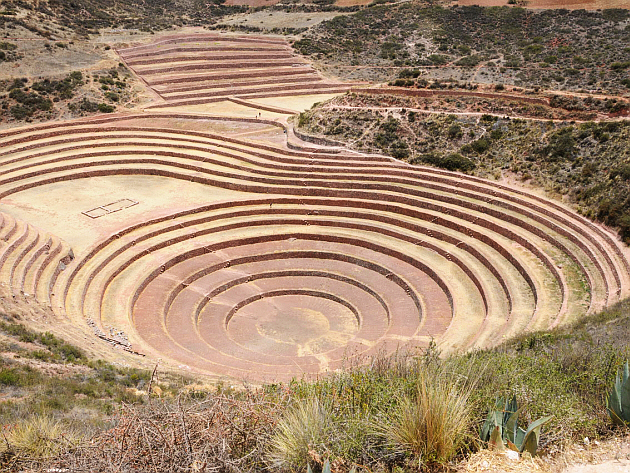
Moray is an agricultural terrace complex northwest of Cuzco, south of the Sacred Valley. It might make some of us think of UFOs or crop circles, volcano craters, but this site is just a man-made agricultural complex. So, it has more to do with potatoes than aliens. Ironically...
Moray is harder to access than most other places in the region, therefore fewer people visit it. There aren't large crowds, so it is easier to take good pictures with you camera without waiting for the flocks to move away.
Moray resembles ancient Greek and Roman amphitheatres and when sighted, the traveler might feel elevated, impressed of the beautiful and almost unrealistic views.
The Moray Terraces are among the most beautiful Inca creations. They must be visited by anyone who takes the time to explore the Cuzco - Sacred Valley area.
The Characteristics and the Purpose of the Moray Terraces
The Incas have experimented with agriculture at Moray. They must have tried out different altitudes, temperatures and soil types for the plants in order to obtain the best results possible.
Experts consider Moray an experimental facility for crops. They say, the Incas planted wheat, quinoa, panti, grain and kantu flowers at Moray and they experimented with different altitudes and light intensities. The deeper something was planted, the cooler it was down there... Each plant reacted differently to water and sunray quantities, as well as to temperature variations. At deeper levels there were lower temperatures, thus simulating the high altitude conditions. Temperature differences between the lower and higher levels are higher than you might think! The difference between the lowest and the highest levels can be up to 15 ºC (59 ºF). This is equal to the difference between sea level temperature and 1.000 m (2,380.8 ft) height level temperature.
The crater-like formations descend to a depth of approximately 150 m (492 ft). As a comparison, we could say that that's as deep as high a 50-story skyscraper is. Some of these "craters" at Moray blend into one another. Some start from each other and go deeper.
Seen from outside, people standing in the center of the deepest crater look like tiny ants. On photos you might believe that these are smaller, basketball-field size areas. Actually, the Moray Terraces resemble more with gigantic mines.
The name of Moray wither comes from maize harvest ("aymoray") or from the dehydrated potato (which is "moraya o moray"). Some affirm that the word can also have a connection with the month of May. There is not exact explanation to why the site was named Moray.
Moray was used for agriculture even until recently, but the exploitation was banned and the archaeological restoration works have started. Today, the site is very well preserved and it is being looked-after.
Moray too has an irrigation system of canals. The system functions like many other similar ones in this part of the country.
One can descend into the "craters" with the use of stair-like stones that were implanted into the edge of each level (into the side of the terrace ring). Although, the access of tourists might not be permitted.
We might never know why Moray was constructed. It was a tremendous effort, but probably there were already "wholes" in the ground and the Incas had exploited the opportunity to turn the place into the beautiful site that we know today.
Historian Edward Ranney tells us that the Incas have used Moray for rather rare plants. Special species like coca leaves might have been planted here.
Throughout the years many explorers have analyzed, studied the site and have come up with a variety of theories... John Earls said he has come across "vertical stones in terraces" that would have served to mark the limits of shadows at dusk during the equinoxes and the solstices.
The same John Earls also said that the different terraces of Moray actually reproduce the multitude of temperature areas that there are in the Inca Empire. The vast Inca Empire's different temperatures can be easily reproduced with this layered construction. Moray could simulate about 20 such temperature categories found across the empire.
Further reasons for the construction of Moray might have been: the crossing of plants (some speculate that the Incas might have tried to create "hybrid" species), the domestication of plants that were originally wild (domesticated plants produce more and are edible), but the Incas could have used Moray for estimating the production of certain plants under simulated conditions.
The Discovery of Moray
Machu Picchu was discovered in 1911 (officially)... Do you know when Moray was discovered? In 1932 only... By Shirppe Johnson's expedition with the help of an airplane. Interestingly, this happened 21 years after the discovery of the "Old Peak".
Sounds encouraging to those who are enthusiastic about hidden cities and forgotten Inca ruins.
Throughout the years many explorers have analyzed, studied the site and have come up with a variety of theories... John Earls said he has come across "vertical stones in terraces" that would have served to mark the limits of shadows at dusk during the equinoxes and the solstices.
The Moray Raymi Festival
The festival-fever also reaches Moray... Sacsayhuamán and Cuzco have the Inti Raymi and Moray has the Moray Raymi Festival. This event at Moray is held in September. Then, locals gather around the Moray site and perform various acts, rituals dedicated to the Inca Sun God, Inti.
Getting to Moray
Moray is reachable on road only from Ollantaytambo or Urubamba or from Cuzco through Chinchero (Chincheros). The best way to get there is by bus from Cuzco. Moray is located at about 60 - 65 km (37.28 - 40.38 mi) from the center of the city. This trip may take about 1,5 - 2 hours one way.
Moray is especially beautiful when the Sun goes down. One can admire the light and shadows passing across the site. For photographers, this is a wonderful place to visit!
When on the road to Moray, you will pass the village of Maras. Nearby are the Salinas (Salt Mines) of Maras. Also worth visiting, if you're in the area. |
|
||||||||||||||||||||||||||||||||||||||||||||||||||||||||||||||||||
 |
|||||||||||||||||||||||||||||||||||||||||||||||||||||||||||||||||||
 |
|||||||||||||||||||||||||||||||||||||||||||||||||||||||||||||||||||
 |
|||||||||||||||||||||||||||||||||||||||||||||||||||||||||||||||||||
|
|||||||||||||||||||||||||||||||||||||||||||||||||||||||||||||||||||
 |
|||||||||||||||||||||||||||||||||||||||||||||||||||||||||||||||||||


 Moray is among the 5 most important places you should visit in this part
of Peru. The magical atmosphere created by the view is doesn't resemble
anything in Peru and mustn't be left out!
Moray is among the 5 most important places you should visit in this part
of Peru. The magical atmosphere created by the view is doesn't resemble
anything in Peru and mustn't be left out!